A Doctor’s Visit at Home
By Peter Vigoda
Problem
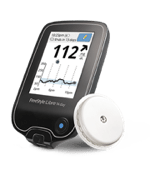
In recent history we have made many advancements in the home medicine field most remarkable is the diabetes monitor device. This device absorbs a drop of your blood and can tell you your blood glucose level, but why is that all it can tell you? A doctor’s visit blood test will tell you the following: white blood cell count, hemoglobin, hematocrit, platelet count, mature neutrophils, lymphocytes, monocytes, eosinophils, basophils, immature granulocytes and many more along with blood glucose levels. So why does the only home blood test only measure one aspect of the blood’s content?
If we were able to conduct at home blood work than anyone from cancer patients in remission to the average joe concerned about their health could do a blood test from the comfort of their house and if the results showed any abnormalities, the blood work results could be sent to doctors for further analysis. This is an important question to ask especially today with the threat of COVID and other pathogens, the risk of getting more sick when going to the doctors is higher than ever. If you are a cancer patient going through chemo than you are more susceptible to getting sick and do not have the immune system to fight off these illnesses, being able to do blood work from a safe environment would reduce the amount of exposure to foreign illnesses for anyone who is most vulnerable to them.
Context
If you are like me then you might come from a family with a history of cancer, this might be a scary thought that you think about often. I used to say if I could get a weekly scan to make sure I am not growing any defective cells that instead of dying off continue to multiply (a cancer tumor) than I would, but a weekly scan would be more harmful than helpful. Over exposure to the radiation from these scans could be the cause of new cancer growth, which is quite an ironic thought. It wasn’t until I went to the hospital to have a swollen lymph node checked, what they did to make sure it wasn’t cancer related was test my blood. Blood tests can be used to determine if you have cancer by testing your white blood cell count, your white blood cell count increases if you are fighting off a cold or having allergies, but if you have cancer your white blood cell count increases drastically. This is one way your body alerts you that you have something wrong with your body, although other abnormalities in your blood can be signs of other medical issues.
The test came back within 24 hours and showed a normal white blood cell count indicating a negative for warning signs of cancer. This was a relief, but it also got me thinking how come we only doctors can do blood tests, we take our temperatures, take pregnancy tests, so why isn’t there a blood test we can do on our own? It wasn’t until I saw someone conduct a diabetic glucose blood test that got me thinking, why can’t a device be made to measure all the content of blood and why can’t it be small enough to fit in my pocket like this person’s diabetic blood tester? The answer to this question is difficult to answer because this device already exists, except this machine is the size of a room and costs a fortune to produce. This device is a series of machines and are only operated by doctors and hospital staff. That’s why only hospitals have them, although then again the first computers used to be the size of fridges and were only owned by institutions and operated by trained professionals and now everyone has a laptop that can be bought anywhere. So with today’s modern technology why can’t we do to the blood testing machines what we did to the computer, make it smaller and available to the average household. You might be saying “why would anyone need that” or “why would I buy a complex machine when I can go somewhere and use one” and that is exactly what people said about the computer.
Tech
A blood test goes as follows: hospital laboratory receives blood sample, the sample is labeled and placed on a fronted automation (a conveyor belt to transfer sample between analyzers), the sample is brought to series of tests including centrifugation process than to the aliquoted process than is barcoded and archived, the an aliquot sample (a portion of the original test) is taken to a sample analyzer, next the sample is walked to the next department where a technologist will place in in another machine for further testing. In fact all of the testing is done automatically by computers, the majority of the time is spent labeling and making sure the samples don’t get mixed up or lost. The first machine the blood is put through does a CBC test (complete blood test) which determines if there’s any abnormalities that need further examining. If further testing is needed they make a blood film review (drop of blood on glass rectangle that is placed on microscope) but it is in fact not a human that uses the microscope. The computer isolates individual blood cells and takes high res photos of them that can determine if the blood is similar to those found in cancer patients. The photo looks like this.
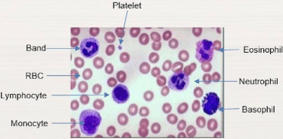
The computer will look at an image like this from a drop of your blood and determine an overall percentage of the platelet, band, RBC, lymphocyte, monocyte, eosinophil, neutrophil and basophil within all of your blood. To determine your white blood cells, plasma and red blood cell count the computer will look at the centrifuged sample, a centrifuge works by spinning the blood sample at high speeds to separate its molecular contents. Just like how oil won’t mix with water the blood content does not mix back together.

Although it seems complex to create a home device that can accomplish these tests it wouldn’t be too difficult. All the code for these tests is already written and the machines already exist, the most complex part of these tests is the transportation of the sample around the lab. My proposal is a single machine with no labeling or archiving process to minimize size of the device. If you are doing it at home there is no need to archive or sort multiple blood samples. The device would need two receptacles, one for your blood sample and a second one for a microscope slide (drop of blood on glass rectangle that is placed on a microscope).The device would have to have its own computer box with a processor powerful enough to run these tests and have a monitor to display results.
Values
The reason this would be helpful to humans is because we are not as informed as we can be. Many people do not know how our body’s work or what makes us unhealthy. By normalizing self care people would become more aware of their health and work harder to increase it. The average person cannot explain how their body works, that is a scary thought. Another scary thought is according to The Guardian “Almost half of people who get cancer are diagnosed late, which makes treatment less likely to succeed and reduces their chances of survival”. Hearing that blows my mind, the thought that half of everyone who has cancer doesn’t catch it soon enough for treatment to be effective is not only sad but preventable. If we can normalize self care and give people the chance to test themselves and understand the data then we can reduce that half to one fourth or even zero.
Even outside of western culture this could have a huge impact. If we can make a blood testing machine that is as small as a desktop computer imagine how just one of those machines in a third world country village would help. Currently it is too expensive to give blood testing facilities to small villages but if they become more compact and cheaper than anyone anywhere could find illnesses faster and treat them faster. By making people more aware of their health and able to track it with ease than we can all become healthier and reduce the amount of suffering around the world.
Redesign
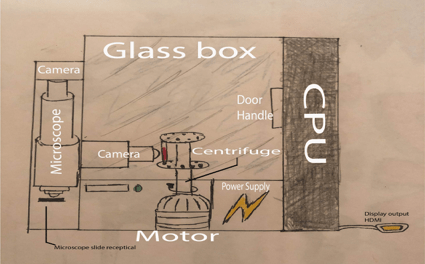
The goal of this redesign is to create a blood analysis machine that is about the size of a desktop computer so it can be kept in everyday households.
-The main part of the device is a glass box with an opening door for the front panel, within the glass box is a camera and a centrifuge, used to spin the blood at high speeds to separate the red blood cells, platelets and plasma. The camera is placed to align with the sample before and after the centrifuge process so it can measure a total amount of fluid than after spinning the amount of plasma and white blood cells.
-Under the glass box is a housing unit for the motor and electrical components to both spin the centrifuge and transfer data from the camera to the cpu.
-To the right of the centrifuge test is a housing unit for the cpu that will run the code that translates images into readable data.
-To the left of the centrifuge is a tall housing unit with a sd style slot where you place the blood film microscope slide, inside this housing unit is a microscope but instead of an eyepiece to look down it has a camera that photographs the slide, this data is also sent to the cpu. Within the cpu runs the code used in hospital testing units to get the platelet, band, RBC, lymphocyte, monocyte, eosinophil, neutrophil and basophil readings
– Finally the cpu would have an output HDMI cable to be attached to any monitor to easily show the data
 Peter Vigoda